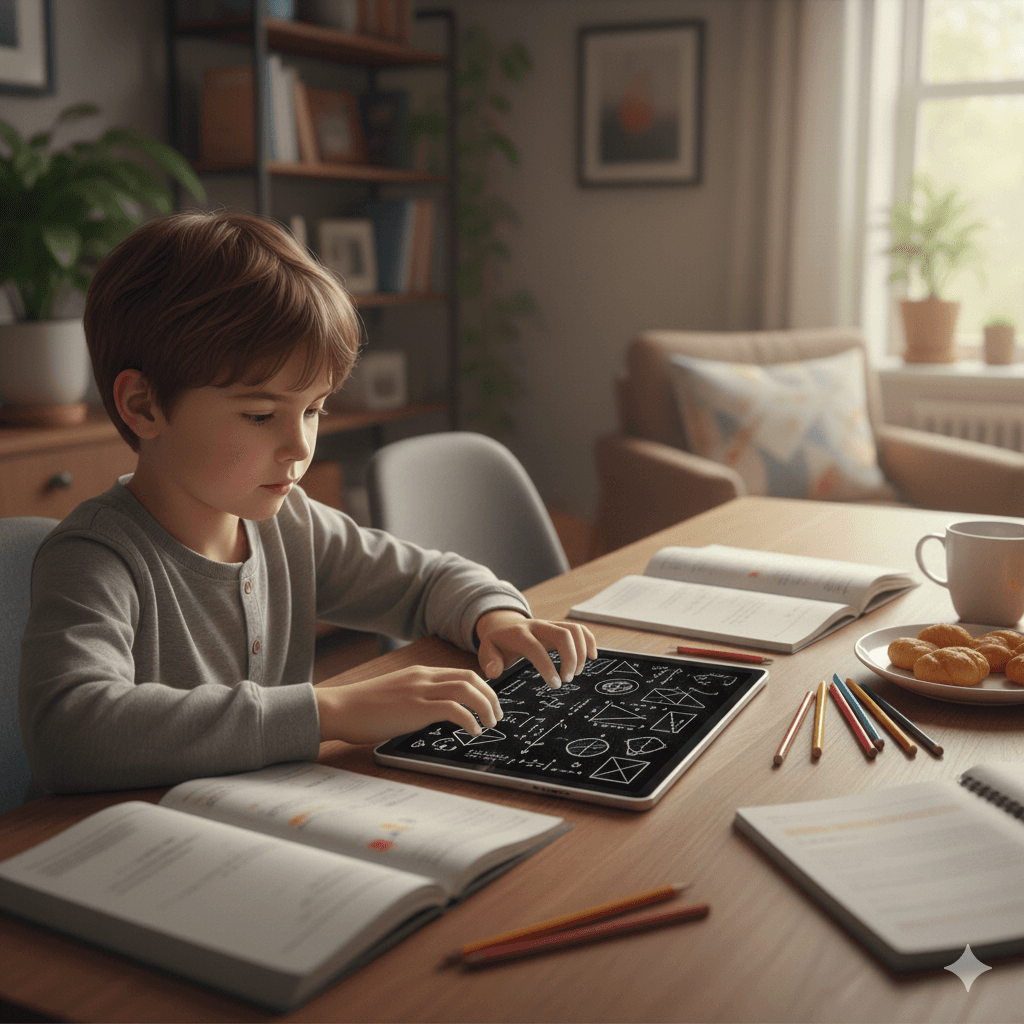
Why Kids Learn Math Better by Talking and Drawing Than by Typing to a Chatbot
PennPaper Team
Watch a good math teacher help a struggling student and you'll see two things happening at once. The teacher is talking, and the teacher is drawing. A number line appears as they explain negative numbers. A rectangle gets split into pieces as they explain fractions. The student points at the board and says "wait, why does that part go there?"
Now watch a child use a chatbot for math. They type a question, awkwardly, because fractions and exponents are hard to type. A wall of text comes back. They read it, or skim it, and type another question.
Both are "getting help with math." But they're very different experiences, and learning science has a lot to say about why the first one works better.
Math is visual
A great deal of mathematical understanding is spatial. Fractions are parts of a shape. Negative numbers are positions on a line. Multiplication is an area. Equations are balances. Graphs are pictures of relationships.
A 2024 meta-analysis in Learning and Instruction, covering 41 studies and more than 10,000 students, found that visualization interventions improved math learning with a medium effect size (g = 0.50), across topics from arithmetic to algebra. We covered it in detail in the science of visual learning in mathematics.
A chatbot can describe a picture in words, and some can generate an image. But describing a fraction bar in a paragraph is not the same as watching it get divided while someone explains what's happening.
Hearing and seeing together beats reading
Richard Mayer's decades of research on multimedia learning produced a set of principles that hold up remarkably well. Three matter here.
The modality principle. People learn better from pictures with spoken narration than from pictures with written text. When the explanation is spoken, the eyes are free to watch the diagram. When it's written, the eyes have to jump back and forth between reading and looking.
Temporal contiguity. People learn better when the words and the matching picture appear at the same time, not one after another. "Now we split this into four equal parts" should happen as the lines appear.
Signaling. Learning improves when the important parts are highlighted as they're discussed. A circle drawn around the common denominator at the moment it's mentioned does exactly that.
A chatbox breaks all three. The explanation is written, the pictures (if any) arrive separately, and nothing is pointed at as it's discussed.
Children think out loud
There's a second reason voice matters, and it's about your child speaking, not just listening.
Self-explanation is one of the most powerful learning strategies we know. Studies going back to Michelene Chi's work in the late 1980s show that students who explain their reasoning to themselves while working, even when the explanation is wrong at first, learn more and transfer it better than students who don't. A child talking through a problem is doing self-explanation naturally.
Typing gets in the way. Younger children type slowly. Mathematical notation is awkward on any keyboard. A 9-year-old who has to hunt for the slash key to write a fraction will write short, simple questions, or give up. The same child talking will say "I don't get why the bottom number stays the same."
Talking reveals thinking. When a child explains out loud, their misconceptions come out with them. "I added the tops and added the bottoms" tells a tutor exactly what to fix. A typed "idk" doesn't.
Chat encourages the wrong kind of help
There's also a design problem. A chat interface is built around question-and-answer. The natural move for a child is to paste the problem and read the reply. The natural move for the chatbot is to answer it completely.
That pattern, research suggests, is where learning goes wrong. A 2025 study in PNAS found students who practiced with a standard chatbot scored 17% lower on a later test than students with no AI at all. See does AI make kids worse at math?
A conversation at a whiteboard has a different rhythm. The tutor draws a step and asks "what do you think comes next?" The child answers. The tutor draws the next step, or a hint. The child does the thinking at every turn.
How PennPaper puts this into practice
We designed PennPaper around the whiteboard, not the chatbox.
- Your child talks, the tutor listens. No typing required, so even younger children can explain what they're stuck on in their own words.
- The tutor draws while it explains. Equations are written line by line, graphs are plotted, shapes are divided, in step with the spoken explanation.
- Your child can draw too. The canvas is shared, so your child can point to the part they don't understand or write their own attempt.
- It asks, not just tells. The tutor asks your child to try each step, and gives hints before answers.
- It's short and focused. Sessions are 15 minutes, which is long enough to understand an idea and short enough to keep attention.
Voice and whiteboard also use far less bandwidth than video. A standard home connection is plenty.
Frequently asked questions
Is voice-based learning better for kids?
For younger children especially, speaking is faster and more natural than typing, and explaining their thinking out loud is itself a powerful learning strategy.
Why do kids need visuals to learn math?
Many math ideas are spatial: fractions, number lines, area, graphs. A 2024 meta-analysis of 41 studies found visual approaches improved math learning across topics.
Can my child use an AI tutor without typing?
Yes, with a voice-based tutor. PennPaper is designed so children can talk to the tutor and watch it draw, with no typing needed.
Is a chatbot good enough for math homework help?
It can answer questions, but text-only chat is poorly suited to how children learn math, and it tends to hand over answers rather than build understanding.
The bottom line
Children learn math best when they can see it, hear it explained and talk through their own thinking. A text box makes all three harder. That's why the best math teachers have always used a whiteboard, and why we built our tutor around one.
Sources: Mayer (2021), Multimedia Learning, 3rd ed.; Chi et al. (1989), Self-explanations, Cognitive Science; Chi et al. (1994), Eliciting self-explanations improves understanding, Cognitive Science; Learning and Instruction (2024), meta-analysis of visualization interventions in mathematics; Bastani et al. (2025), PNAS